


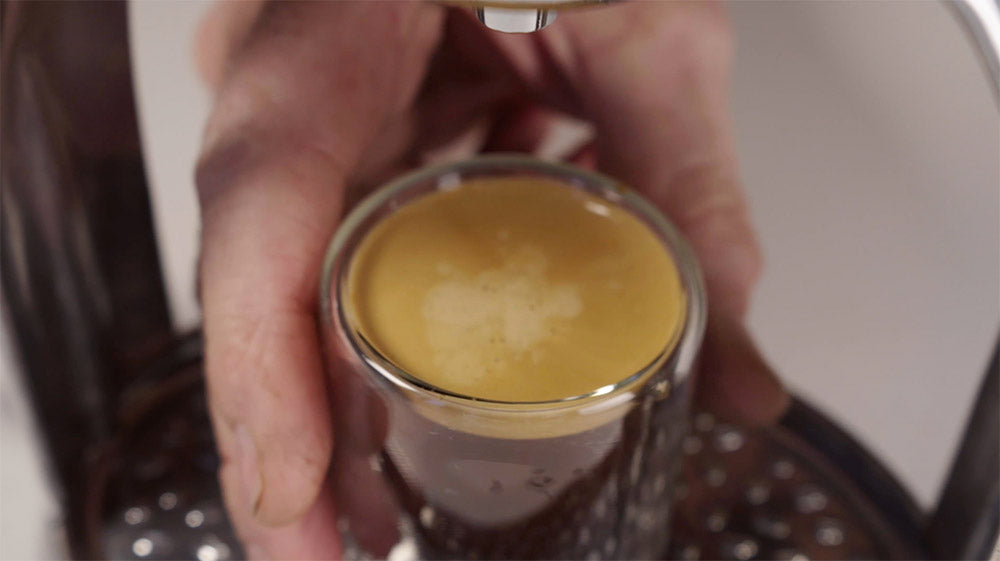
The short answer: espresso tastes best in the cup at around 140–158 °F, not scalding hot. That is the range set by the Italian Espresso National Institute (67 ± 3 °C, about 153 °F) and the temperature a ROK espresso reaches: about 154 °F, measured by World Barista Champion Dale Harris on the ROK Presso Smartshot.
Many people assume hotter coffee is better coffee. The standards, the science and the world's leading baristas all say otherwise. Very hot water pulls out harsh, bitter flavors, and very hot coffee hides the sweetness and fruit you paid for in good beans.
Is brewing temperature the same as drinking temperature?
Three temperatures matter, and they are often confused:
|
Temperature |
What it means |
Typical figure |
|
Water going in |
The water you start with |
Freshly boiled, or 190–205 °F on an electric machine |
|
In the coffee during the shot |
What the grounds actually experience |
Always cooler than the water, as it meets room-temperature coffee |
|
In the cup |
What you drink |
140–158 °F for a normal espresso |
Even an electric machine set to 199 °F brews at an average of about 187 °F in the coffee, according to Barista Hustle. Every espresso brews cooler than its water and arrives cooler still.
 What temperature should espresso be?
The coffee world's own standards put espresso in the cup well below boiling:
|
Organisation |
Guidance |
|
Italian Espresso National Institute (INEI), Certified Italian Espresso |
Espresso in the cup 67 ± 3 °C (about 153 °F); water at the outlet 88 ± 2 °C (about 190 °F); 25 ± 5 seconds; 9 ± 1 bar |
|
Specialty Coffee Association (SCA), Coffee Value Assessment (2024) |
Professional tasters let coffee cool to about 158 °F before tasting, then keep tasting as it cools below body temperature |
|
National Coffee Association (USA), espresso |
“Nearly boiling water”, a shot in about 20–30 seconds, and “warm your cup” so it doesn't cool your espresso |
A ROK espresso, at about 154 °F in the cup, sits right in the middle of the Italian standard.
Does hotter water make better espresso?
Research points the same way: hotter coffee tastes more bitter, and very hot water mostly adds the harsher flavours.
- Hot coffee tastes more bitter. In a study in Food Chemistry (Steen et al., 2017), coffee served at 50–62 °C tasted more roasted, bitter and intense. As it cooled to 31–44 °C, sweet and fruity notes came through.
- Hotter water adds the late, harsher compounds. Researchers at ZHAW in Switzerland brewed espresso at 82, 92 and 96 °C (Sánchez López et al., 2016). Hotter water increased aroma extraction mainly late in the shot, when roasty and bitter compounds come out.
- Quick shots keep more aroma. A 2024 study in Scientific Reports (Smrke, Eiermann and Yeretzian) found shots under 10–15 seconds already reached over 80% of their maximum extraction, and fast shots kept more of the most delicate aromas.
- Temperature matters less than people think. UC Davis researchers, supported by the SCA's Coffee Science Foundation, brewed coffee at 87, 90 and 93 °C (Batali, Ristenpart and Guinard, 2020). With strength and extraction held equal, brew temperature had little effect on taste.
- People prefer it around 60 °C (140 °F). Several consumer studies put the typical preferred serving temperature at about 60 °C (140 °F).
What do coffee experts say about espresso temperature?
The best-known names in coffee agree that hotter isn't better.
- Dale Harris, World Barista Champion (“The truth about thermals”, YouTube, May 2025): “Hotter isn't better, just different.” Too much temperature, pressure or time pulls out harsh flavors. A normal finished espresso is 60–70 °C (140–158 °F), and flavor is best appreciated below about 55 °C (131 °F).
- Lance Hedrick, coffee educator (“Science says stop drinking hot coffee”, YouTube, October 2026): recommends brewing espresso at around 176–180 °F, even for very light roasts. He advises letting espresso cool a little rather than drinking it as hot as possible, because the hottest coffee tastes most bitter.
- James Hoffmann, World Barista Champion (via Sprudge, September 2010): fellow champion Gwilym Davies told him he enjoyed espresso more once it had gone almost cold. Hoffmann tried it: “It was seriously, shockingly tasty… Acres of sweetness, lovely clarity of flavor.”
Why does café espresso sometimes feel hotter?
If espresso tastes best below 158 °F, why does café espresso sometimes feel hotter? Mostly for practical reasons, not flavor:
- Customers expect it. Many people judge coffee by how hot it is, so cafés serve it hot to avoid complaints.
- Ordinary cups lose heat fast. Cafés rarely serve in double-walled cups, so they start hotter to make up for the heat the cup takes away.
- It has to survive the wait. A drink carried to a table or out of the door needs to start hot to still be warm when you drink it.
None of these make the coffee taste better. They make it stay hot for longer.
 How hot is espresso from a ROK manual espresso maker?
The ROK Presso Smartshot and ROK EspressoGC are manual espresso makers: no electricity, no boiler, just freshly boiled water from your kettle and your own hands on the levers.
- Freshly boiled water. This matches the National Coffee Association's “nearly boiling water”. During the shot, Dale Harris measured the extraction temperature on the Smartshot starting in the 60s °C (140s–150s °F) and peaking in the 80s °C (around 180 °F).
- No need to preheat the water chamber. Metal chambers on other manual and electric machines soak up heat from your water. You don't need to preheat a ROK: its chamber is made from an insulating material that takes almost none, so the heat stays where it belongs, in your coffee.
- A quick, hands-on shot. A ROK shot takes around 25–30 seconds, within the 20–30 seconds the National Coffee Association recommends. Quick shots keep more aroma.
- The right temperature in the cup. About 68 °C (154 °F), measured by Dale Harris on the ROK Presso Smartshot: inside the Italian standard of 67 ± 3 °C.
How do you make espresso at the right temperature at home?
Four simple steps give you the right temperature every time:
- Use freshly boiled water. Straight from the kettle.
- Warm your cup. Fill it with hot water while you prepare the coffee. A cold cup can take up to 10 °C (18 °F) off your espresso (Dale Harris).
- Warm the portafilter. Dunk it in boiled water for about 15 seconds before filling it with coffee.
- Pull the shot straight away. Fill the chamber and press while everything is warm.
Making an americano, latte or flat white? You're adding hot water or hot milk, so the temperature of the shot matters less. It's straight espresso where not too hot is best.
Then give it a moment. As Lance Hedrick and James Hoffmann both point out, espresso gets sweeter as it cools a little. Try sipping it at different points and see what you prefer.
For FAQs click here
Sources
- Italian Espresso National Institute (INEI), Certified Italian Espresso parameters
- Specialty Coffee Association, A System to Assess Coffee Value (June 2024), sections 5.2 and 5.3
- National Coffee Association, How to brew espresso
- Batali, Ristenpart and Guinard (2020), UC Davis Coffee Center, via the SCA
- Smrke, Eiermann and Yeretzian (2024), Scientific Reports
- Steen et al. (2017), Food Chemistry
- Sánchez López et al. (2016), International Journal of Mass Spectrometry
- Dale Harris, “The truth about thermals”, YouTube, May 2025
- Barista Hustle, Temperature equilibrium in espresso
- James Hoffmann, room-temperature espresso, reported by Sprudge (2010)
- Lance Hedrick, “Science says stop drinking hot coffee”, YouTube, October 2026


